
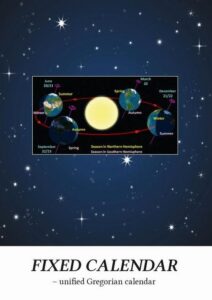
Fixed Calendar – unified Gregorian calendar
Opis
The calendar we use today is basically the Julian calendar – introduced in 45 BC by Julius Caesar. In 1582 Pope Gregory XIII made only a minor amendment to this calendar concerning leap years in order to prevent the calendar from lagging behind the solar year by 1 day in every 128 years – minimising this error to 1 day in every 3322 years.
When it was first created, there were only two versions of the Julian calendar. The first was the ordinary year calendar and the second was the leap year calendar. The division of the calendar into weeks increased the number of versions from two to fourteen, and the introduction of a moveable Easter meant that since 325 AD we have been using a calendar in as many as 490 versions – each year the calendar brings us a different arrangement of weeks and holidays, a different number of working and non-working days.
The industrial age created the need for sorting out the excessive diversity prevailing in many areas. A new field was developed – standardisation – which includes, among other things, unification, that is reducing issues to a single form or standard.
In 1834, Marco Mastrofini (1763-1845), an Italian priest, philosopher and mathematician, proposed the unification of the calendar and the introduction of a fixed calendar.
Half a century later, the French Astronomical Society organised a special competition to create a new, fixed calendar.
A number of other proposals were also put forward before World War One. Enthusiasts of reforming the calendar managed to get the International Congress of Chambers of Commerce to pass a resolution in support of the reform, while the Swiss government pledged to take appropriate diplomatic action.
In the turbulent 20th century, the issue of calendar reform was not forgotten – just postponed until calmer times. We are now in the third decade of the 21st century and there is nothing to suggest that calmer times are ever to come. It is high time to seriously address the issue of
introducing a fixed calendar – the unified Gregorian calendar.
Szczegóły
| Autor | Stanisław Kostka Szymański |
|---|---|
| Wydawca | Bookplan.pl Joanna Zimny |
| Formaty | |
| ISBN | 978-83-966007-1-4 |
Na czym przeczytasz
Czytniki: Kindle, PocketBook, inkBOOK, Onyx Boox i inne. Telefony i tablety: dowolna aplikacja do EPUB (Apple Książki, Google Play Książki, Moon+ Reader). Komputery: Calibre, Thorium Reader. Bez dodatkowych kont i aplikacji. Zobacz poradnik